AsyncAPI JetBrains Plugin: Empowers Spring Messaging
See how the AsyncAPI JetBrains plugin finds every Spring Kafka, Pulsar, Amazon SQS/SNS, JMS and STOMP mappings, listeners and handlers in your project, maps the messaging topology, catches bugs like a missing @KafkaHandler or a duplicate consumer group, and exports it all to AsyncAPI
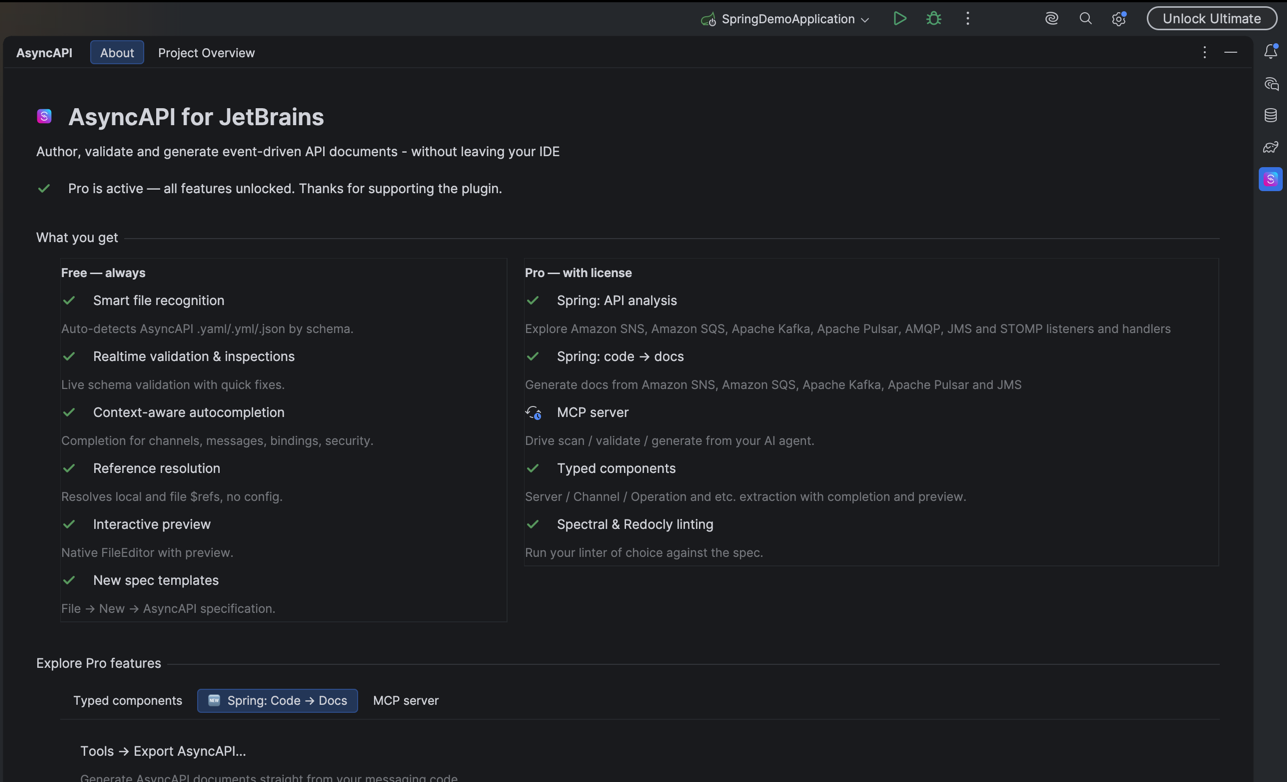
How the AsyncAPI Plugin Helps Spring Engineers in IntelliJ IDEA
The AsyncAPI plugin for JetBrains IDEs now understands Spring Messaging. It automatically discovers, visualizes, and inspects your event-driven code across Amazon SNS, Amazon SQS, Apache Kafka, Apache Pulsar, RabbitMQ, JMS, and STOMP right inside IntelliJ IDEA
These features are implemented trough IntelliJ SDK, so no compiled or running application required. They work the same whether you’re on IntelliJ IDEA Community or Ultimate
Here’s what it brings to your day-to-day work with Spring and messaging
Project Overview
This is the most valuable feature since day one. It doesn’t matter you are working on a project, that grew too fast or one you inherited from someone else. Every newly added channel, operation or protocol will be discovered automatically
You run your Spring Boot app and… “Wait, which APIs does this thing even expose?!”
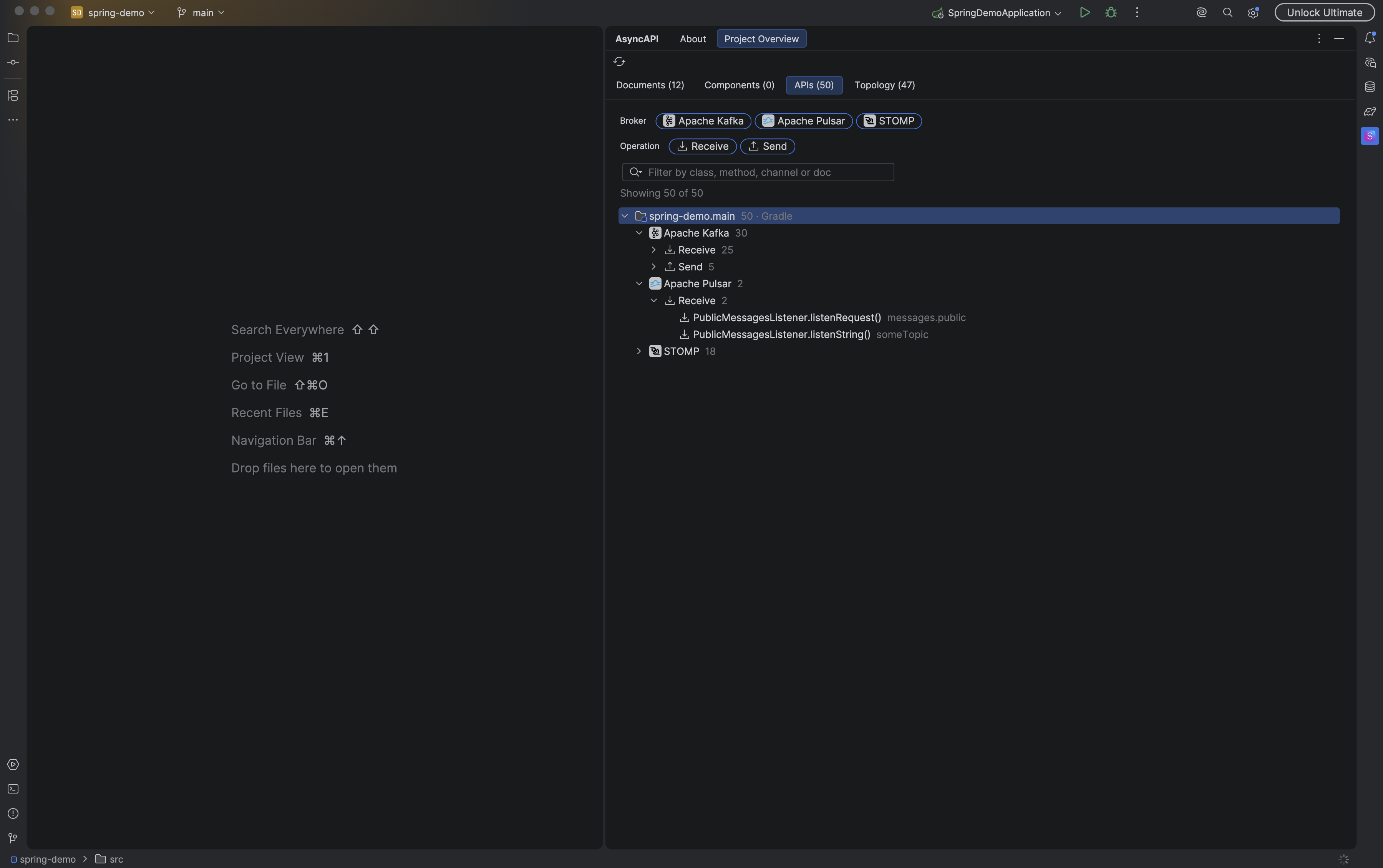
Project Overview scans every module in your project and puts your whole event-driven surface in one place
Message handlers and listeners
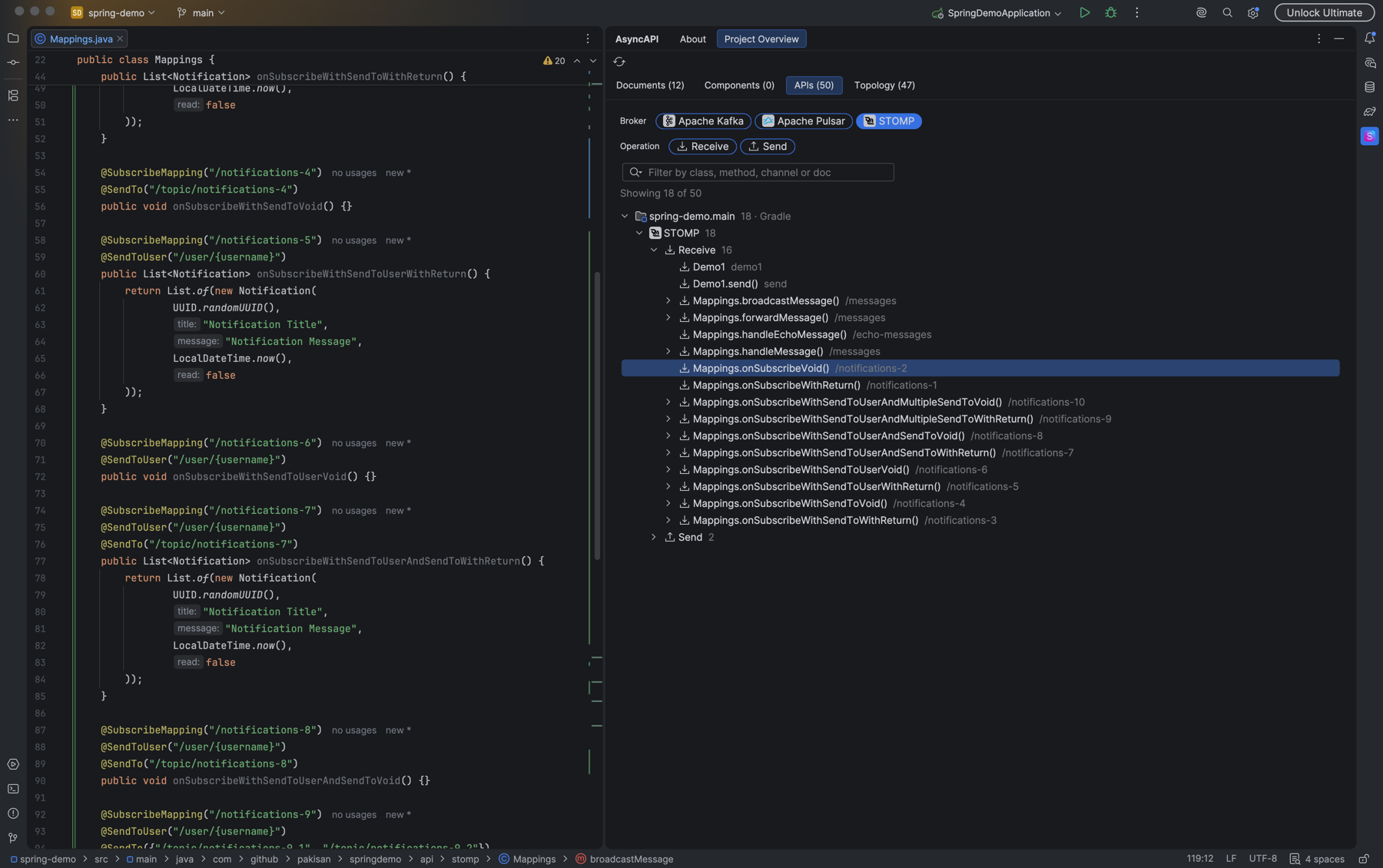
The plugin collects and visualizes messaging endpoints across your codebase, so you can see your event-driven architecture at a glance instead of searching for annotations by hand
Amazon SNS
1
2
3
4
@NotificationMessageMapping   // on a plain @Service, not a @RestController/@Controller
public void onOrder(@NotificationMessage Order order) {
    // some logic
}
Amazon SQS
1
2
3
4
5
6
7
8
9
10
11
12
13
14
@SqsListener("orders-queue")
public class Handlers {

    @SqsHandler(isDefault = true)
    public void a(Order o) {
        // some logic
    }

    @SqsHandler(isDefault = true)
    public void b(Refund r) {
        // some logic
    }

}
Apache Kafka
1
2
3
4
@KafkaListener(topics = "orders.placed", groupId = "billing")
public void onOrderPlaced(Order order) {
    // some logic
}
Apache Pulsar
1
2
3
4
@PulsarReader(topics = "orders", startMessageId = "somewhere")
public void onOrder(Order order) {
    // some logic
}
JMS
1
2
3
4
@JmsListener(destination = "orders-queue", selector = "(type = 'ORDER'")
public void onOrder(Order order) {
    // some logic
}
STOMP
1
2
3
4
5
6
@MessageMapping("/chat")
@SendTo("/topic/messages")
public OutputMessage send(Message message) throws Exception {
    String time = new SimpleDateFormat("HH:mm").format(new Date());
    return new OutputMessage(message.getFrom(), message.getText(), time);
}
Endpoints are attributed to the right module and broker for both Gradle and Maven source sets, and are searchable by class, method, or Javadoc.
Every row links straight to its method or class in the editor. It stays fast on projects with hundreds of listeners
Message publishing
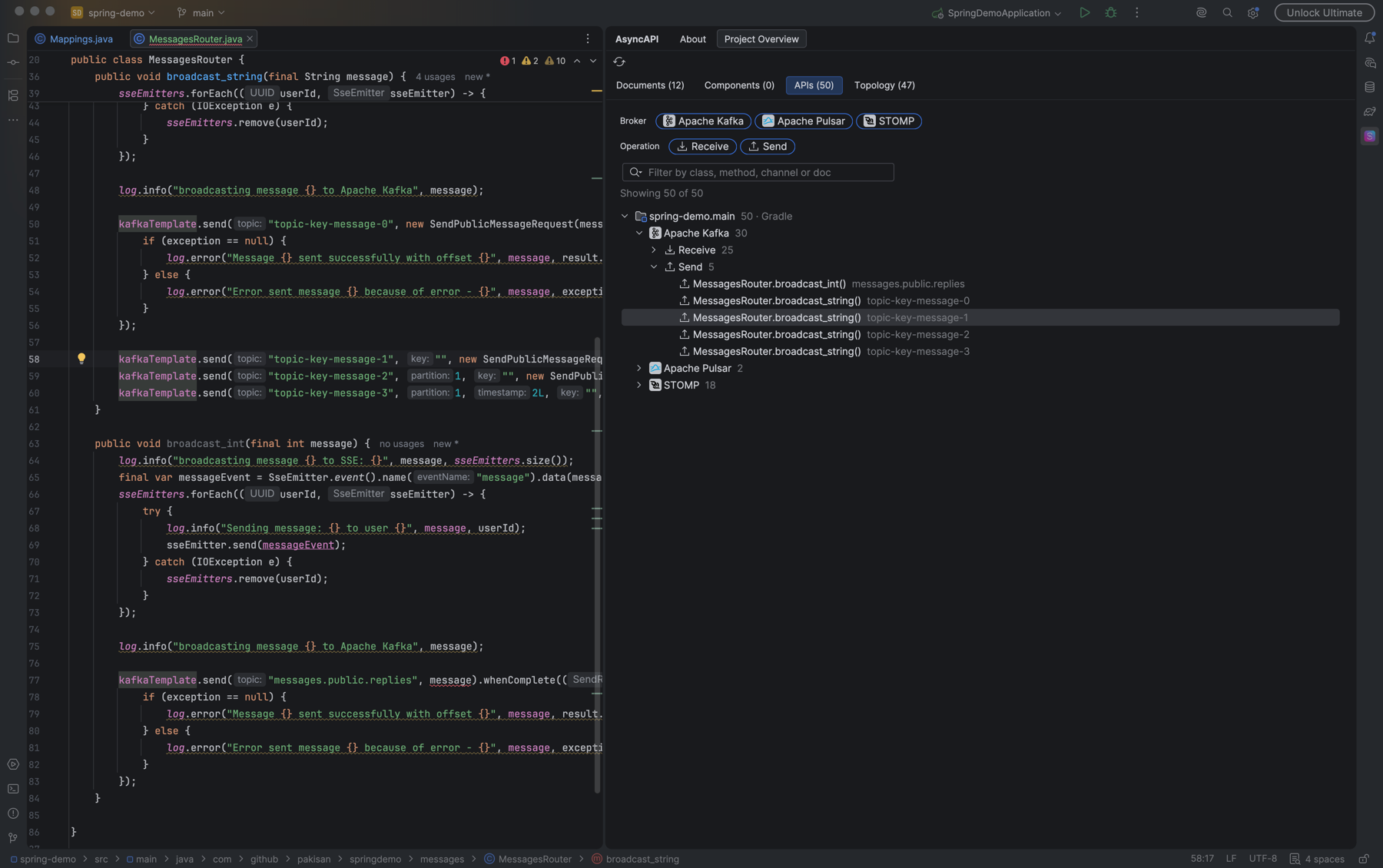
The plugin finds every place where your code publishes messages
KafkaTemplateRabbitTemplate/AmqpTemplateJmsTemplate/JmsMessagingTemplatePulsarTemplateSqsTemplateSnsTemplateSimpMessagingTemplate(STOMP)
and reports the destination reported exactly as written in your code
Messaging Topology: linking producers to consumers
Project Overview links senders to the listeners that consume the same channel, and lays the whole picture out as a topology. A listener and a sender that name the same channel differently — a literal on one side, a ${property} placeholder or an @Value-injected field on the other are recognized as the same channel
The project is laid out by channel instead of by code:
- producers
- consumers
and the flows between them, readable hop by hop across module boundaries, plus a traffic view for channels your project only consumes or only publishes
It also covers hidden publishes - a listener that publishes further down its own call chain (through a service, a port, an interface) is found automatically and marked as an inferred route, kept visibly distinct from a route the code declares directly
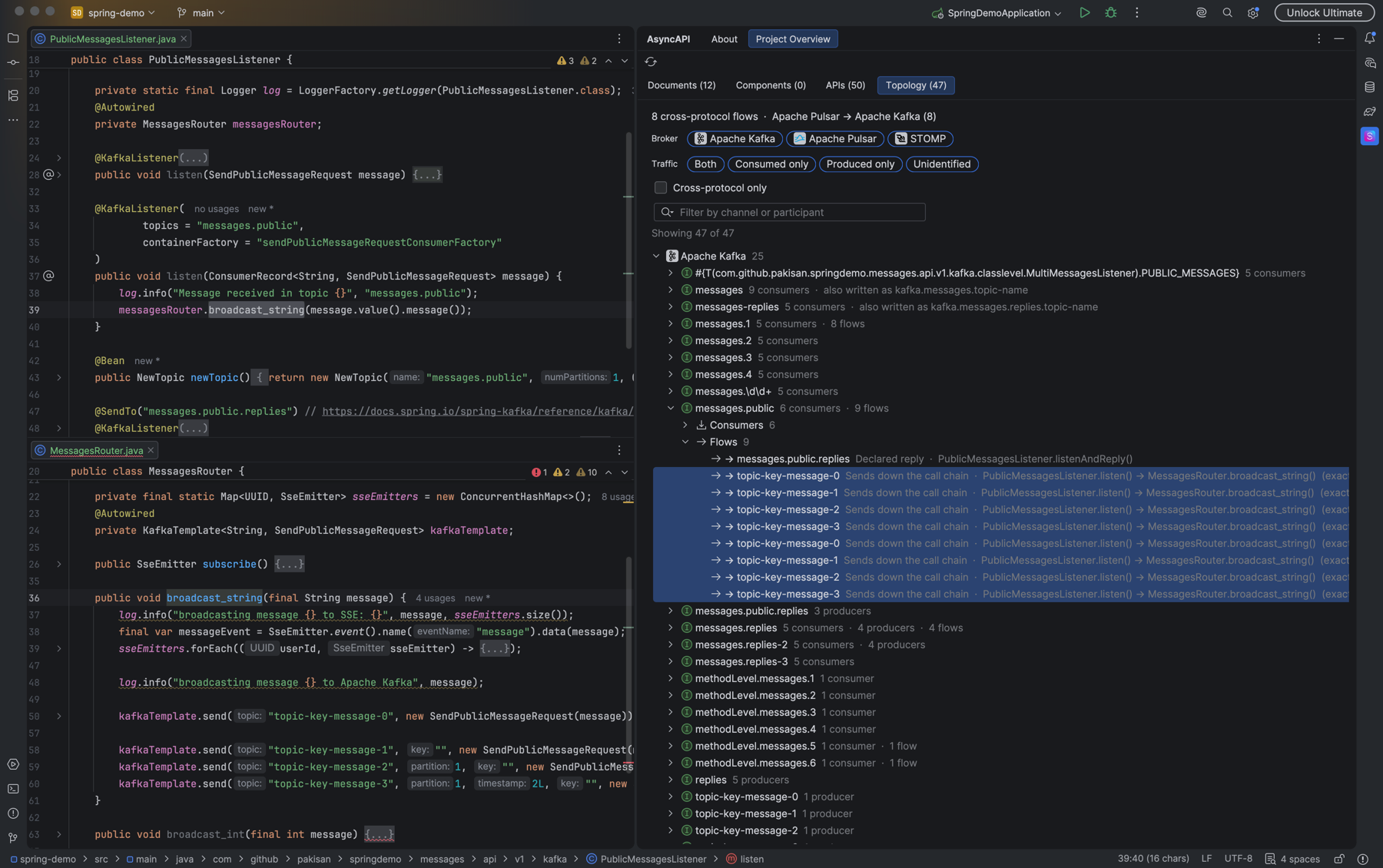
Send and receive directions
Every module and broker splits into Receive and Send, with a dedicated Operation filter to narrow the tree to one direction
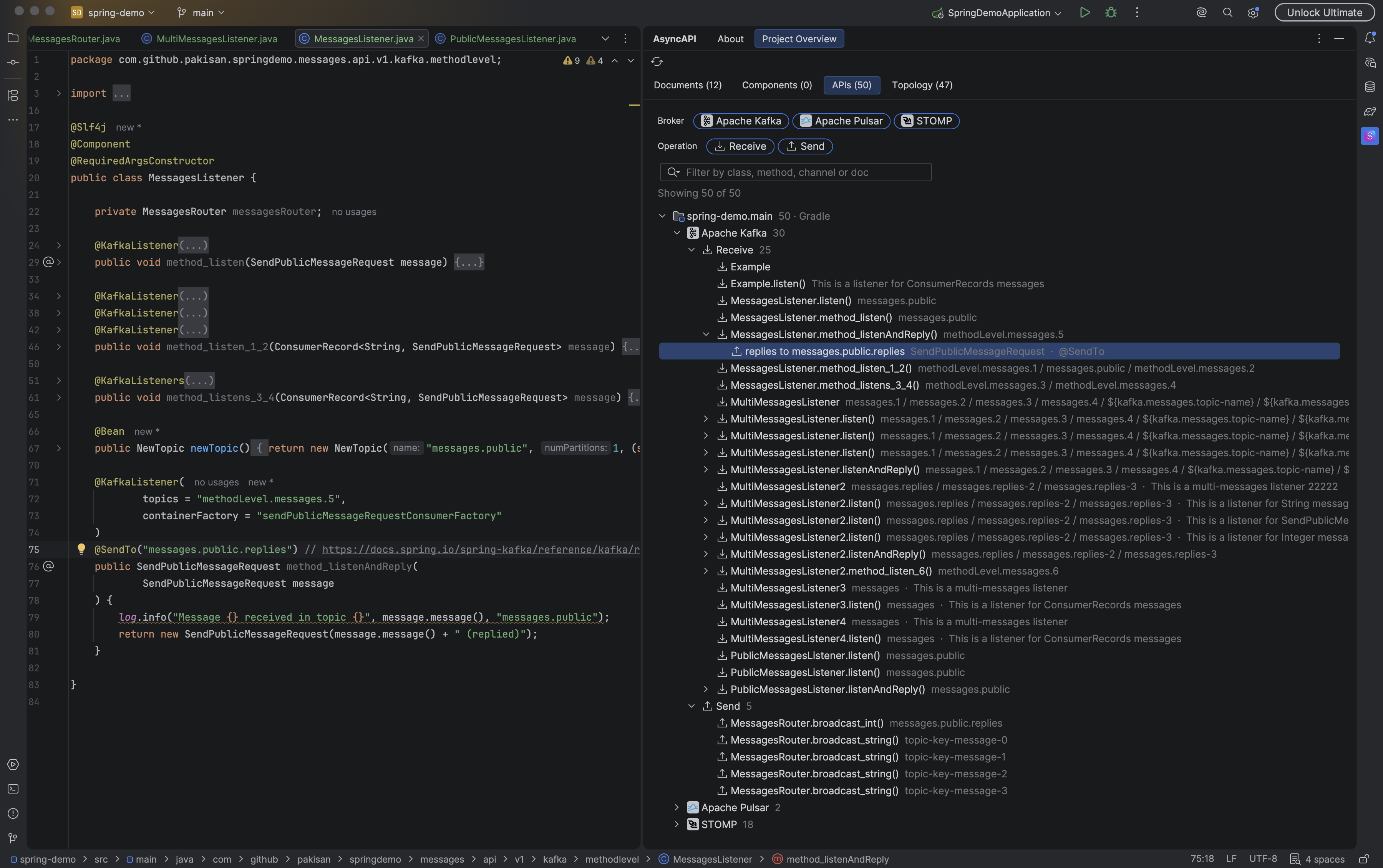
Replies
Listener that answers on another channel (@SendTo, or a reply-to header on RabbitMQ and JMS) is shown right next to the listener that produces it
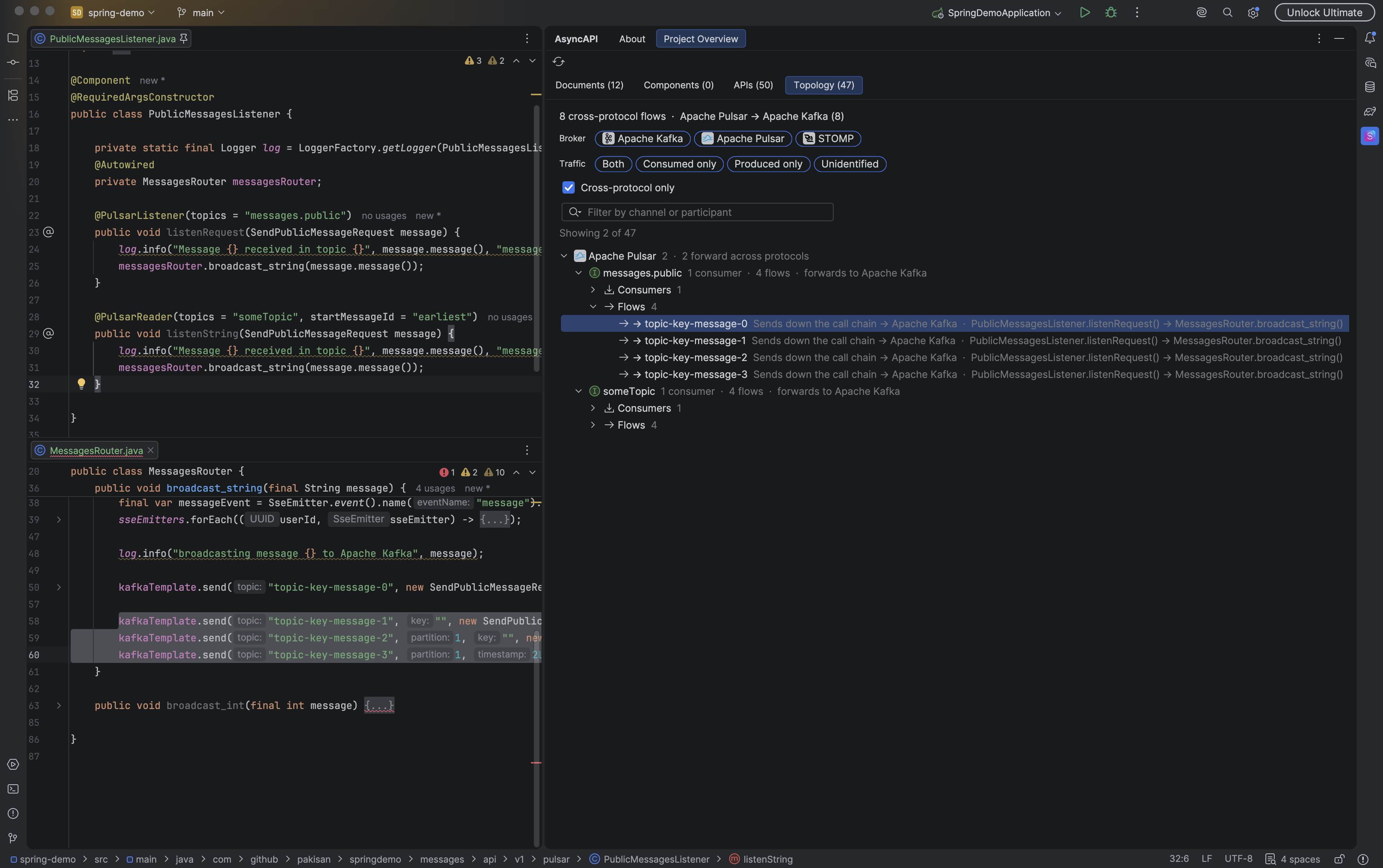
Cross-protocol messaging
Listeners or handlers which are forwarding messages from one protocol to another
For example, an Apache Pulsar listener that receives messages from messages.public channel and forwards them to Apache Kafka topic-key-message-* channels
Code inspections
No more annoyed application startup exceptions when your forget to add @KafkaHandler in your @KafkaListener class
1
2
3
4
5
6
@KafkaListener(topics = "my-topic")
public class Example {

    public void listen(ConsumerRecords<String, SendPublicMessageRequest> records) {}

}
Or undefined behavior when several @KafkaListener are working with same topic and consumerGroup
1
2
3
4
5
6
@KafkaListener(topics = "orders", groupId = "orders-service")
public void handleOrder(Order order) {}

// elsewhere in the project
@KafkaListener(topics = "orders", groupId = "orders-service")
public void handleOrderAudit(Order order) {}
Number of available inspections for supported protocols:
Amazon SNS- 6 checksAmazon SQS- 14 checksApache Kafka- 13 checksApache Pulsar- 8 checksJMS- 5 checks
Export
Project Overview finds your messaging code and export turns it into an AsyncAPI document - one per environment, for Apache Kafka, Apache Pulsar, Amazon SQS, Amazon SNS, and JMS
Bindings, topic and queue names, FIFO detection, and dedup settings are read from what the code actually does, not typed in by hand and left to drift
Even cross-protocol message forwarding will be exported
1
2
3
4
5
6
7
8
9
10
11
12
13
14
15
16
17
18
19
20
21
22
23
24
25
26
27
28
29
{
  "operations" : {
    "receive_SendPublicMessageRequest_from_messages.public": {
      "action": "receive",
      "channel": {
        "$ref": "#/channels/messages.public"
      },
      "title": "PublicMessagesListener.listenRequest()",
      "messages": [
        {
          "$ref": "#/channels/messages.public/messages/com.github.pakisan.springdemo.messages.api.v1.dto.SendPublicMessageRequest"
        }
      ],
      "x-forwards-to": [
        {
          "operation": "#/operations/send_SendPublicMessageRequest_to_topic-key-message-0",
          "channel": "#/channels/topic-key-message-0",
          "protocol": "kafka",
          "via": "call-chain",
          "confidence": "exact",
          "path": [
            "PublicMessagesListener.listenRequest()",
            "MessagesRouter.broadcast_string()"
          ]
        }
      ]
    }
  }
}
❤️ Thanks for Your Support
A huge thank you to everyone who has tried the plugin, reported issues, shared feedback, or spread the word. Your support directly shapes where this project goes next.
Have ideas, questions, or feature requests? Drop me a message - I’m always happy to chat.